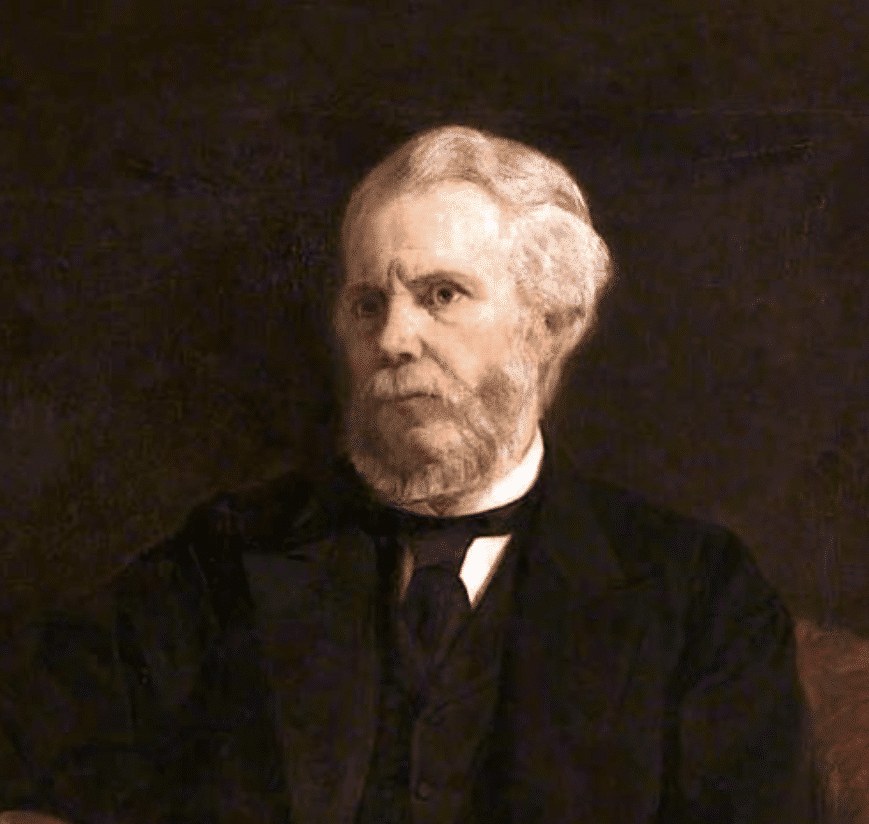
Richardson Thomas Johnson, architect (1846-1929)

The Royal Court Theatre was designed by local architect, Richardson Thomas Johnson
By Wigan Local History and Heritage Society for the King Street Heritage Project
Richardson was born in Stepney in East London in 1846. The 1851 census records Richardson and his parents living in Saint Mary Newington, London. His father, William, was an engine maker from Wigan and his mother Eleanor Eliza Wild (1825-1915), was from Antwerp in Belgium. The family moved from London to Wigan in the 1860s to allow his father to manage the family public house, the Hole I’th Wall, on Cooper’s Row, off Marketplace. The census of 1861 records Richardson as a scholar at Well Hall School, Clitheroe. By 1871 he was living with his parents in the Hole I’th Wall while developing a business as an architect.
He was the Secretary of Wigan Cricket Club in 1869 and 1870, and by 1876 he had an architectural practice working from Hopwood Chambers in King Street. He has an extensive list of achievements, including Grimes Arcade completed in 1870 when he was 24, now a Grade II listed building. In 1886 he did the original design for the Royal Court Theatre. Still standing it underwent further redesign by James Priestley Briggs in 1899.
Read More
The Empire Palace Theatre was redesigned from the Alexandra Music Hall in 1892 and he was also the architect and designer for the Springfield Trotting and Athletic Ground which was later named Springfield Park and became Wigan Athletic Football Club’s ground. He designed many smaller building and houses throughout Lancashire including a bridge at Saltcoats near Lytham.
Whilst in Wigan he lived in Darlington Street, Hodson Street and Caroline Street.
He married Alice Maud Grylle (1854-1911) in 1880 in Wigan and they had three children. Francis Mitchell Grylle Johnson (1878-1922), Alice Maud De Courcy Johnson (1881-1970, who married Henry Arthur Kewell) and Eleanor Eliza Johnson (1883-1962).
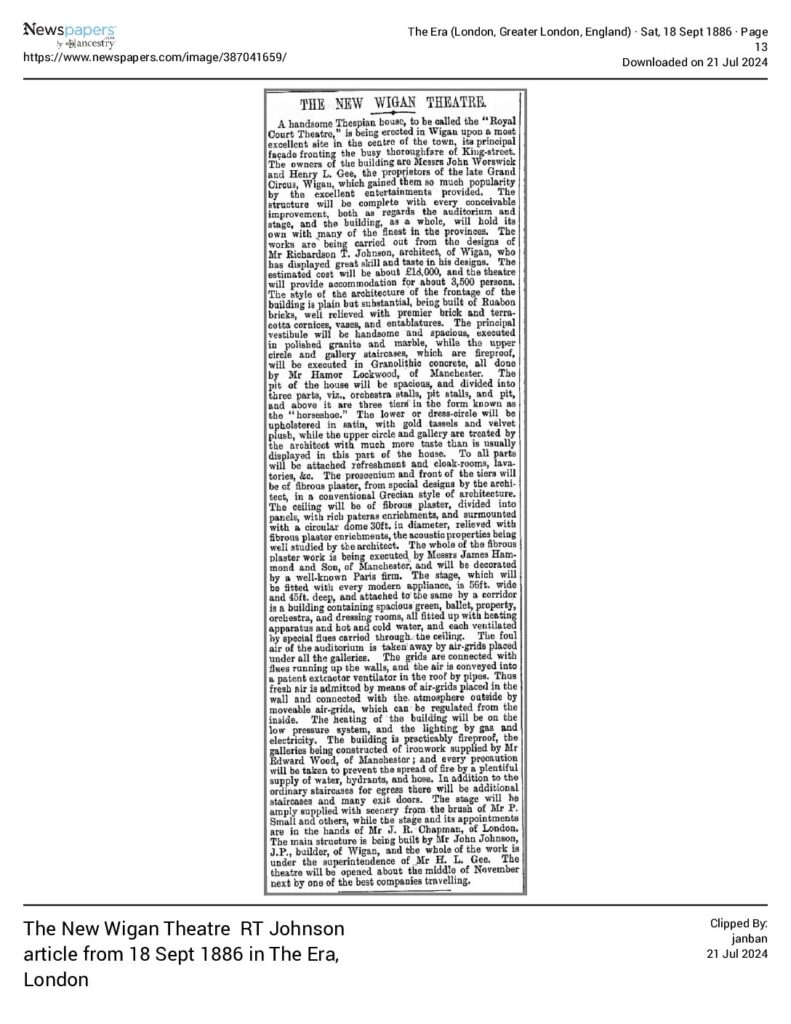
In the 1901 census he was living with his wife, Alice, and their two daughters Alice Maud and Eleanor at 63a Elizabeth Street, Blackpool with an architectural practice in the town. His wife died in Blackpool in 1911 and shortly after he was recorded as living a with his daughter, Alice Maud, in Liverpool, aged 63 and a widower.
The 1921 census shows him working as a parcel clerk for a firm of milliners and living with his daughter, Alice Maud, and her husband and their son, Frank, at Agnes Steet, Liverpool. He died in1929 at Rice Lane Walton, Liverpool also known as the Workhouse and was buried at St Anne’s Church, Stanley in Liverpool.
Sources:
Archives:Wigan and Leigh Aancestry.co.uk
findmypast
Lancashire Online Parish Clerks
Read more Wigan history articles below…

New Members, click on the link below and complete our simple online form to become a member:
Please click here to join now
Existing members, please click on the link below and complete our renewal form:
Please click here to renew your membership