The Life of Thomas Taylor, Mill Owner and Magistrate (1808-1892)
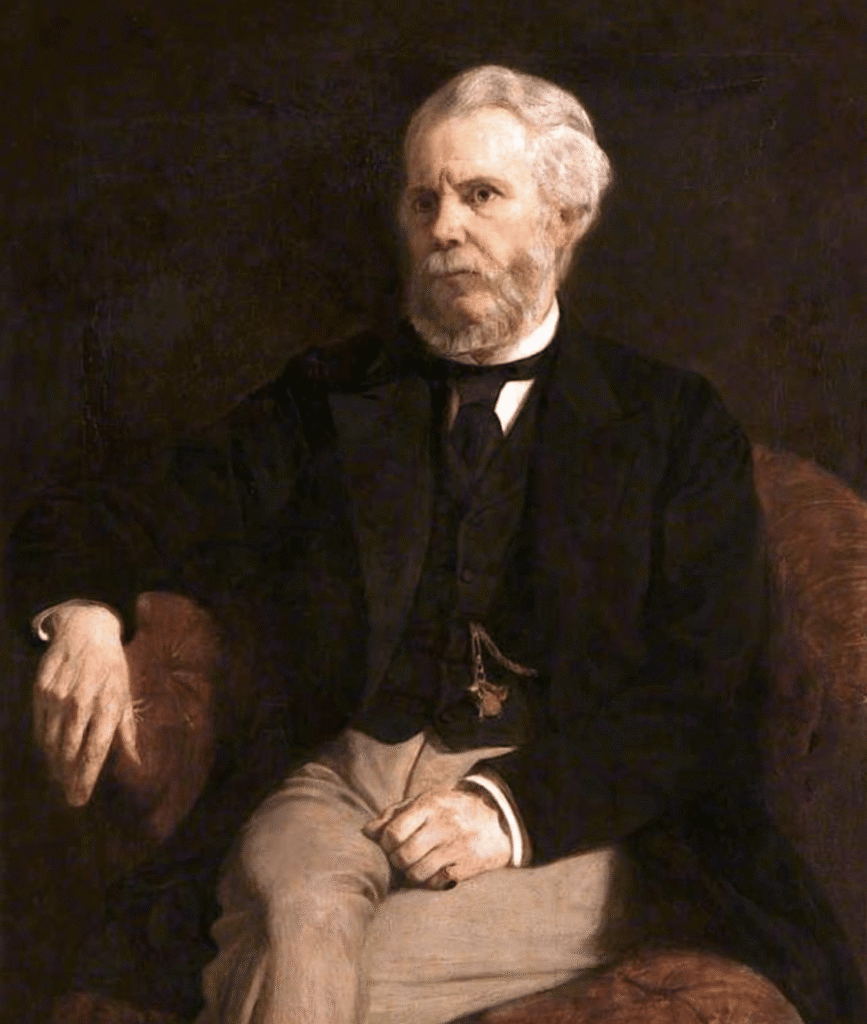
Thomas Taylor, Mill Owner 1808-1892
Thomas Taylor was born in Wigan and was an early pioneer of the mechanised production of the processing of cotton. With his brother, James, he founded Victoria Cotton Mills in Wallgate. At its prime in the 1860’s Thomas Taylor and Brother employed more than 3,000 people with over 1,600 looms on their Wallgate site.
Thomas Taylor loved his hometown of Wigan. In 1877 he built and became benefactor of the Wigan Free Library (now Wigan Museum). He took great interest in seeing how his library was being patronised. In the early 1880’s when he had retired to his country estate of Aston Rowant in Oxfordshire, he established one of England’s greatest private art collections.
Whilst not exactly a ‘rags to riches’ story Thomas was able to exploit the opportunities presented by the town of his birth, principally the transport links which enabled American cotton to be imported via the port of Liverpool, the ready supply of coal and local engineering skills to power the steam engines which powered the production of finished material from raw cotton on a scale of quantity and quality which was to bring about the death knell of what had previously been a cottage industry within the town.
The Early Years
Thomas Taylor was born in Wigan on 10th December 1808, the second son and fourth child of James and Mary Taylor who lived in King Street. James was described as a currier (leather dresser) when he married Mary Hopwood at Wigan Parish Church in July 1803. Later James and Mary would become the proprietors of the Tannery, Hough Wood, near Billinge. The family also had premises in Cross Keys Yard in Wigan Market Place, this establishment was used for the manufacture and trading of their leather products. Mary Hopwood’s father had been a Linen Manufacturer who lived in Millgate.
Thomas had three brothers and four sisters. We can trace the lives of six of them. John Fogg, the oldest 1804-1853, Mary Fogg 1805-1812, Elizabeth 1807-1880, James 1810-1850, Ellen born 1812, Mary Fogg 1815- 1838 and Richard 1816-1855, we are still trying to trace Ellen.
Later in life Thomas would prove to have wonderful memory and would fascinate his friends and relatives with his stories recollecting his childhood memories.
Thomas could recollect a windmill in Scholes used for grinding corn and a watermill on Scholes Bridge. He remembered standing on the corner of King Street, in 1815, when the London stagecoach arrived bringing important news from overseas. The Mayor made an announcement from the steps of the Clarence Hotel in Wallgate declaring the British victory over Napoleon Bonaparte at the battle of Waterloo. Thomas could also recall that in Commercia Yard, off the Market Place there was a large steam driven corn mill. He recalled that in 1816, Wigan had no regular supply of mains water and the general public had to rely on wells or spring water. In the town centre itself, a few of the main streets had water supplied by wooden pipes being brought from the Whitley pond at Whitley Hall situated between Whitley Crescent and Wigan Road.
He recalled that well-to-do local women would be transported around the town centre in sedan chairs carried by their manservants.
Thomas along with John Fogg and James followed their father and mother into the tannery business, whilst Richard trained as a surgeon.
In April 1819, their father, James, died from inflammation brought on by an infection. He was 50 years old and was buried in the churchyard at Wigan Parish Church. This left Mary to continue to run the family business and bring up her young family.
Business Life
After their father’s death, the three brothers John Fogg, Thomas and James took up currier work helping their mother maintain the tannery business and run their retail outlet in Wigan Market Place.
John Fogg left the family business in 1820s to start in the linen and cotton trade and in about 1832 his younger brother, James, also decided to try his hand in the cotton industry. James’s first venture into cotton spinning was in a small mill in Church Street, near to St. George’s Church and the old Drill Hall.
Prior to 1818 and the introduction of the first powered looms, spinning and weaving was done manually on spinning wheels (The Spinning Jenny) and hand looms, usually in people’s homes. One particular area of Wigan well-known for this tradition was Hallgate where there were rows of terraced cottages, known as Top and Bottom Croft, specifically used for cotton and wool processing. This form of manufacturing process is what is now recognised as cottage industry. Thomas recognised the change and used mechanised machinery to do the spinning and weaving work which was much quicker and less labour intensive than the manual processes.
In a decisive turn of events in 1834, Thomas left the family business to join James in the cotton trade and their new enterprise was known as Thomas Taylor and Brother.
On 14th November 1834 Thomas purchased 3,248 square yards of agricultural land known as “Guagers Meadow” off Miry Lane, running parallel to Wallgate. This piece of land was purchased from Henry Bullock of Queen Street, a cotton spinner. It was here in 1836 that Thomas built and opened his first small cotton mill and this would later become known as Number One Victoria Mills. The brothers continued to use the mill in Church Street acquired by James, but the main centre of business was in Wallgate. In 1838 Thomas’s elder brother John Fogg Taylor was declared bankrupt the petitioners for bankruptcy being Thomas and James. John Fogg subsequently became estranged to the family and emigrated to Australia.
In 1844, the Taylor brothers were looking to expand their business empire and acquired more land and property. Firstly, on 16th April 1844 they purchased land adjacent to Victoria Mill on the northeasterly boundary from Thomas Lyon a landowner, who owned land on Wallgate to the south of Faggy Lane. There is still a Lyon Street between Clayton Street and Great George Street off Wallgate. On 3rd August 1844 an existing mill and land on the northern boundary were purchased from Henry Bullock, a cotton manufacturer and dealer, and three times Mayor of Wigan. He was made a burgess of Wigan 1800. Mayor in 1820 1822 and 1827. This property was to become Number Two Victoria Mills which opened in 1846. On 30th November 1853 more agricultural land was purchased in Leeds Street again from Thomas Lyon this was to be the foundation for further expansion.

In December 1857 the brothers purchased more plots of land along Leeds and Clayton Streets again from Thomas Lyon. With the additional floor space acquired, 1858 saw the opening of Number 3 Mill to complete the development of Victoria Mills. The Taylor brothers were regarded as one of the founders of the mechanised cotton industry in Wigan. Brother Richard gave up his medical career in the late 1850’s to become a partner in the business.
The Church Street site was put up for sale in 1863 so that the brothers could concentrate on the main Wallgate manufacturing site.
Law and Local Politics
In 1848 Thomas Taylor was placed on the commission of the peace (Justice of the Peace) in the County Magistrate Court of Wigan. Thomas was elected Chief Magistrate of the Wigan County Bench in 1854.
Thomas became a well respected member of the Wigan Town Council representing All Saints Ward. On 9th November 1854 he was elected Mayor of Wigan and a few days later appointed his brother, Richard, as his deputy mayor.
Only four weeks into his office Thomas suffered a serious accident whist out riding near “The Larches” which was at the top of Wigan Lane, close to Sicklefield. He met his groom, Henry Woods, who was riding one horse and leading another, as Thomas passed the un-ridden horse it “shied” and caused Thomas’s horse to rear and throw him to the ground. One of his ankles was severely crushed by the horse’s hoof. Initially it was feared that he had sustained life a threatening injury, luckily the damage was not as serious as first suspected and he went on to make quick and full recovery and was soon able to carry out his duties as Wigan’s Mayor.
Home Life and Family
The 1851 census gave Thomas as living at “The Elms” Wigan Lane, head of household, unmarried, 43 years old with the occupation of cotton spinner and farmer of 76 acres.
“The Elms” , a large, detached house built in the eighteenth century was located just off Wigan Lane opposite the Plantation Gates in the grounds of what is now Wigan Infirmary.
Thomas married Helen Biggs in 1857 in London when he was 49. Helen was born in Leicestershire and was much younger than Thomas, she was 23 when they married. The newly married couple visited Rome for the Easter celebrations that year.
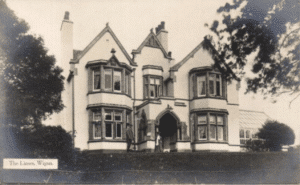
In 1858 their daughter Edith Helena Taylor was born, in 1859 a son Henry Hopwood Taylor was born, but tragically died in infancy. Their second daughter, Mabel Mary, was born in 1861, followed in 1862 by third daughter Beatrice Katherine. During this period Thomas was having a mansion built at Boar’s Head in Standish, which he named “The Limes”. The 1861 census showed him living there with his occupation as a farmer and cotton spinner.
In 1863, he and Helen visited Egypt, this could have been for business or for pleasure.
Thomas had purchased a grand house in London and 1871 census shows the family living there in Hyde Park Gardens. The household consisted of Thomas, a cotton spinner and landowner, Helen and their three daughters, Edith, Mabel and Beatrice. The household had nine servants.
In 1876 on a tour of Switzerland with her parents their eldest daughter, Edith, contracted typhoid fever and died. Edith had gained entry to Girton College in Cambridge and was due to start her first term following the tour. In memory of Edith, Thomas donated £1,000 pounds to college funds which helped to build the new college, designed by architect Alfred Waterhouse who designed the Free Public Library which Thomas had funded.
Thomas’s mother, Mary, had remained in Wigan, living in King Street. She died in February 1850, age 73. She was buried, like her husband, in Wigan Parish Church churchyard.
Cotton Famine and Fortune
During the 1850’s and early 1860’s Thomas made several trips to the southern states of North America buying raw cotton to transport across the Atlantic for processing back in Wigan. It was during one of these visits, shortly before the outbreak of the American Civil War (1861 to 1865), that Thomas had the foresight that made him his fortune. Predicting what was about to happen in the United States, he bought all the stocks of raw cotton he could possibly obtain. For the four years of the war, the Eastern seaboard was block-aided preventing the passage of goods from either leaving the United States.
On arrival home Taylor stockpiled the raw cotton as possible in his warehouses. As the cotton famine took its toil, the price rose at an incredible rate. It was the foresight and shrewdness to import and store the cotton, that enabled Thomas to rule the market and make his colossal fortune.
For his competitors, the shortage of raw cotton led to a lack of work for workers in the mills and large-scale unemployment. Taylor and Brother were one of only a few mills that managed to remain open full time. On 3rd January 1862 Wigan Cotton Relief Committee was formed to help alleviate the distress caused by unemployment in the local cotton industry.
An appeal was made for funds and on the first day a total of £1,075 was raised in subscriptions including £50 from the Mayor, John Cross, £200 from the Earl of Crawford, £250 from Nathanial Eckersley, £100 from Henry Woods and £50 from John Lee and son. Thomas donated £100. By 18th January the fund had collected over £2,000. The relief was in the form of tickets that were given to the needy who in turn could exchange them for essential goods in the local shops. Wigan was the first town to create a relief fund, soon after every other local borough followed the town’s lead in helping those without work.
Thomas Taylor and with his friend, Nathanial Eckersley, were the biggest employers in Wigan. Thomas Taylor’s cotton products gained a great reputation especially in Egypt, China and Japan. Taylor’s yarns and cloth were quoted as being the world standard for quality.
In 1882 the business of Thomas Taylor and Brother became a limited liability company with 30,000 shares at £10 per share being issued. Thomas Taylor (London) became chairman of directors whilst the other directors were Richard Taylor, his younger brother (Wigan), Joseph Crook (Bolton), Robert Gill (Liverpool), George McCorquedale (Newton le Willows), Duncan Matheson (Manchester) and R.C. Snape, son of his sister Elizabeth, (Wigan).
Aston Rowant and Later Life
In 1859, Thomas purchased the country estate of Aston Rowant in Oxfordshire. And whilst living here he was made High Sheriff of Oxfordshire in 1863.
The estate consisted of a fine manor house which boasted an ornamental staircase and picture gallery, a country park with gardens and a two and a half acre lake. It was here that Thomas concentrated on his passion for art. During the 1870’s and early 1880’s he built up a large collection of fine artwork painted by contemporary artists. On its completion Taylor’s gallery collection at Aston Rowant was regarded as one the finest private art collections in the country.
On Saturday 28th April 1883 a sizeable collection of his artwork collection was sold at auction at Aston Rowant including works by Edwin Long, John MacWhirter and Luke Fields for a grand sum of £34,500 a considerable sum in that day. The Derby Daily Telegraph reported on the sale ….. ‘bought in years when his mills were exceptionally prosperous. In the case of Saturday’s sale, for instance, Mr. Thomas Taylor sold ” The Widower ” (by Luke Fildes) for two thousand guineas, a sum exactly double that which he originally paid.’
The reason for the sale of the artwork is not known but it may be that the returns from the mill were not keeping up with the running costs of the estate, so Thomas was downsizing and exiting gracefully from the business.
In 1891 census, Thomas, Helen, and Mabel are recorded at Aston Rowant. The following year the Taylor family had relocated back to the north of England to Park Street in Southport. Thomas’s health had deteriorated, and Southport was thought to be a better environment and climate.
Final Days
On 11th March 1892, Thomas visited the Free Public Library in Wigan to make arrangements for the official opening of the extension to the reading room. Four days later, he died, in Southport, aged 83. His coffin was brought by train to Wigan and thousands of people lined the streets to witness the coffin travel through the town centre. The funeral took place in the Non-Conformist chapel at Lower Ince Cemetery where Thomas was buried. His mother Mary and wife Helen are remembered on the grave. His young son Henry Hopwood Taylor who died in 1860 at The Limes is also buried in the cemetery.
The grave was restored by Wigan Corporation in 1955 in commemoration of his donation of the Free Public Library to the town.
In April 1892 Helen presented Wigan Corporation with a large portrait of Thomas which had been painted by James Archer RSA, 20 years earlier. The portrait can be seen at the top of this post and in Wigan Museum.
Helen, Mary and Beatrice moved to London and in 1911 are as listed as living in Cheyne Walk by the River Thames in Chelsea. Mabel died in 1918. In 1929, Helen died, age 94, and was cremated in Golders Green in London. Her ashes were scattered on Thomas’s grave in Wigan. The youngest family member Beatrice died in 1934.
Acknowledgements
This post is based on an article found in Wigan Local Studies. The author was C Swift whose identity remains a mystery. The article was written in 2008 to mark the 200th birthday of Thomas Taylor. So we are grateful to C Swift for their research and writing it up in to such a detailed account. Thanks too to Gill Clough and Catherine Clarke for their help and additional contributions.
The original article gives information about Thomas’s siblings and we intend to write posts about them shortly.
Read more Wigan history articles below…


If you would like to join the society, please click here to complete the membership form.