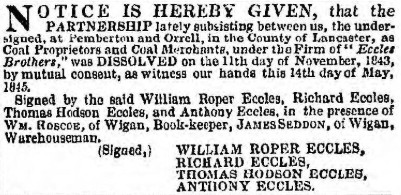
Peter Grant: A Notable Figure in the Temperance Movement (1792-1878)

An advertisement dated 1847 revealed that the Rowbottom family had vacated Rowbottom Square, Rowbottom House had changed ownership, the historic house had been converted into a Temperance Hotel with both commercial and private rooms, managed by Peter Grant.
By Wigan Local History and Heritage Society for the King Street Heritage Action Zone
Research note; Whilst researching the Rowbottom family of Rowbottom House, Rowbottom Square, Wigan, I discovered an intriguing advertisement. It revealed that the Rowbottoms had vacated Rowbottom Square by then, and Rowbottom House had changed ownership. The historic house had been converted into a Temperance Hotel with both commercial and private rooms, managed by Peter Grant. During my exploration on the Wigan World website, I found a discussion about Rowbottom Square, where John Baldwin mentioned that Peter Grant was his ancestor.
“Peter Grant was my 3 x g grandfather, originally from the Strand area of London and Thomas Nicholson, a lowland Scot travelling draper from Dumfriesshire was his son-in-law and he had moved the Temperance Hotel to Dorning Street by 1871. Peter moved to Manchester in the late 1850s and ran a Temperance Hotel off Deansgate in the Cathedral area, returning to die in the Dorning St Hotel (The Grand Hotel) in 1878 aged 85 outliving Thomas by a year.”
I left a message asking him to get in touch. Two years later, he did, sharing the remarkable story of his three-times great grandfather.
Read More
Tracing the Legacy of Peter Grant: A Dedicated Temperance Advocate
Peter Grant (1792-1878) was a notable figure in the Temperance Movement, known for his transformation from a “reformed drunkard” to a respected advocate. Born in the parish of St. Mary-le-Strand in the centre of London, both his parents, Peter and Frances, had died before the first census, limiting the trace of his early lineage.
Temperance Movement and Leadership
Peter Grant joined the Temperance Movement in 1833 and managed Temperance Coffee Houses and Hotels in Wigan and Manchester from the 1840s to the 1870s. His commitment led him to become the Vice Chair of the British Temperance League from 1863-1866. Records from the Livesey Collection, including minute books and member registers, confirm his leadership within the movement. His presence in the Temperance Hotel on Victoria Square in Manchester is also noted.
Independent Order of Rechabites
Peter’s engagement with the Independent Order of Rechabites, a fraternal organisation advocating temperance, began in 1838. He held the position of trustee from 1859-1871, participating actively in the High Movable Conference meetings from 1863-1865. Noteworthy is his role as a speaker in 1867 at a significant meeting with Neal Dow, a leading temperance campaigner from Maine, USA. His resignation in 1871 was marked with accolades for his dedicated service.

Rechabite Walks, Broad o’th Lane in Shevington in 1917, photograph from Wigan World
Personal Life and Legacy
Peter was born on 2nd December 1792, in Swan Yard, off the Strand in London. His father was a bricklayer, a respected occupation. Peter married Elizabeth Champion in 1819, with whom he had several children. Elizabeth died in 1835. In 1845 he married Gillis Stuart. Known as “Flying Moses” for his bright red hair and evangelistic zeal, Peter was an influential figure in the temperance community.
Final Years and Death
Peter returned to Wigan before his death and died on 25th June 1878 at the Temperance Hotel in Dorning Street (Grand Hotel). His obituary highlights his lifelong commitment to temperance. He is buried in Lower Ince Cemetery, Wigan, with his dedication to abstinence memorialised on his headstone.

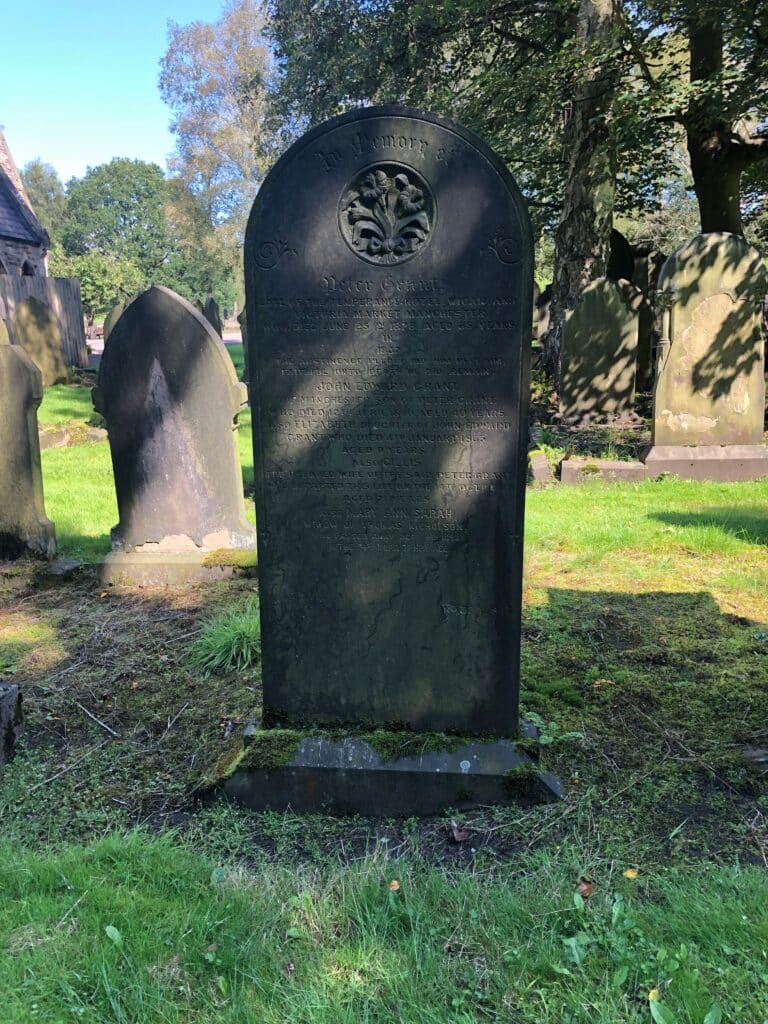
Peter Grant was born in 1793 in London. He died in 1878 in Wigan, aged 85. His gravestone reveals that he was late of the Temperance Hotel, Wigan and the Victoria Market. It says ‘In 1838 his abstinence pledge did him reclaim. Faithful until death did he remain.’

The Grand Hotel, Dorning Street as it stands today. The left half of the frontage is the original Victorian building. The right half with the gables is from the twentieth century. Image by Christine Thompson.
By John Baldwin: Three times Great Grandson of Peter Grant
“Flying Moses”
Peter Grant is my 3 x great grandfather and despite the fact that he was born in the eighteenth century, I have a direct link to him, to the extent that my mother told me what her grandmother told her about him and her grandmother was Peter’s granddaughter, being alive for the last 19 of his years. Having said that, the direct information is extremely modest, namely that he had bright red hair, and that people used to say, “There goes Flying Moses and his granddaughter.” I can’t blame my mum, however, as she was only nine when her grandmother died, so she did well to remember anything.
Peter Grant was born on 2nd December 1792 at Swan Yard, off the Strand in London, the son of Peter and Frances Grant.
Peter senior was a bricklayer, an occupation of sufficient standing to cause him to make a Last Will and Testament at a time when his children were all minors and to have led to him being qualified to vote in the Westminster constituency election of 1806 candidates:
Richard Brinsley Sheridan (playwright)
Admiral Hood (Napoleonic naval officer)
James Paull (Scottish politician)
Peter voted for the latter – was Peter Scottish himself?
Swan Yard was sited opposite Somerset House, roughly where Montreal Place/India Place between Strand and Aldwych are today. Peter was soon baptised in the Parish Church of St Mary le Strand, on 13th January 1793.
Two of Peter’s siblings died young, only his elder sister, Mary, living into adulthood, She married Edward Dunn Cole, a grocer in New Church Court also in the parish of St Mary le Strand. Peter senior died in 1808 when his son was 15.
Peter was married first in 1819 to Elizabeth Champion, four years his junior, the marriage being witnessed by Mary, his sister, and her husband, Edward. Elizabeth was born in the Lying in Hospital in Holborn, the daughter of William Champion, a Painter and Glazier and his wife, Elizabeth, the latter being from Beccles in Suffolk and who lived to the great age for the time of 81 years. Two of Elizabeth’s siblings, Samuel and George were “Professors of Music”, such representing music teachers, as I understand it, the Champion family being based in Marylebone.
All Peter’s children were born to Elizabeth between 1820 and 1830. From 1820–1823 the family lived in Clerkenwell (children John Edward and Elizabeth Frances were born there), then Bear Yard, Strand in 1824 where my Great Great Grandmother, Mary Ann Sarah Grant, was born. Peter’s occupation was a Victualler, meaning a seller of alcohol. Resident at Arrow Court, Chancery Lane, in 1826, a second son, Peter, was born. It is not too difficult a leap to understand that Peter’s next recorded occupation as a Law Writer/Solicitor’s writing clerk fitted neatly with being trained in that location. However, by 1828 when daughter Frances was born, the family had relocated to Lancashire, the first record being in Hindley, where last son Samuel was born (and died) in 1830.
By 1833 Peter had moved to Liverpool where he appears on the register of electors for Shaw’s Brow, somewhere around where the Central Library now stands. It was in that year that he became identified with the Temperance Movement. Elizabeth died there in 1835 and is buried in Everton Necropolis, leaving Peter widowed with a young family.
Peter is reported as chairing the Christmas Day Tea Party at the Commercial Hall in Wigan in 1837 and the following year he joined the Independent Order of Rechabites, a fraternal organisation and friendly society associated with Temperance, existing today as “Healthy Investment”.
By 1841 Peter was resident with his family at Victoria Street, Wigan and in 1845 he married Gillis Stuart (1807–1876) at Wigan Parish Church, one of the witnesses being a Hannah Nicholson. Gillis was born in Plymouth in 1807 and her mother, Mary George, was Cornish, but the Stuart family seems to have strong Lancashire connections to the Garstang area and Wigan.
In August 1846 Peter briefly addressed the World’s Temperance Convention at the Covent Garden Theatre in London as a delegate of the Wigan Parent Society, admitting to being a “converted drunkard” before being shut down by the assembly.
By 1848 Peter had opened a Temperance Coffee House/Hotel in Rowbottom Square off Wallgate in Wigan, the entrance being “up the square next to Mr Wall’s, Printer”. There were “Commercial and Private Rooms”. He is recorded there up to 1854. Meanwhile, in 1853, his daugher, Mary Ann Sarah, married my Great Great Grandfather, Thomas Nicholson (1813–1877), from Cummertrees, Dumfriesshire, one of the Scotch Travelling Drapers who settled in Blackburn and later Wigan, a widower.
Peter’s interests moved to Manchester in the later 1850s, opening a Temperance Coffee House/Hotel in Queen’s Arms or Queen Anns Entry/Smith Door, 15/17 Deansgate, by 1861.
Mary Ann Sarah and Thomas were running a Temperance Hotel (part of the now defunct Grand Hotel) on Dorning Street, Wigan, by 1871.
In October 1865 Peter addressed the opening of a Temperance Hall in Wigan and at some point he became a Vice President of the British Temperance League and an active member of the executive. He continued to run “Grant’s Temperance Hotel” which the Deansgate premises had become known as, along with Gillis’ younger brother, John Stuart (1823– 1896) although Peter and Gillis had moved to a personal address at 54 Stocks Street, Cheetham Hill, Manchester by 1871. Then aged 78, Peter still gave his occupation as Temperance Hotel Keeper. By 1873 the hotel had moved to 28 Fennel Street, behind Manchester Cathedral and was under the name of John Stuart although still called “Grant’s Temperance Hotel”.
Peter and Gillis moved to Ebor Terrace, 48 Great Cheetham Street in Broughton, Salford where Gillis died in 1876. Peter must then have moved back to Wigan to his daughter, Mary Ann Sarah and family and he died at the Temperance Hotel on Dorning St on 25th June 1878 aged 85. Peter and Gillis are both buried in Lower Ince Cemetery, Wigan and his Temperance is memorialised on the headstone – “Abstinence did him reclaim; faithful unto death he did remain.”
John Stuart, (Gillis’s brother), on the other hand, weakened and by 1881 had moved to Hull, where he had become a “publican”, having been twice widowed, living at the Waverley Hotel on Southport Promenade, run by two of his sisters, by 1891, dying there in 1896.
Peter Grant ‘the Third’ (1826–1899) had moved back to his grandmother, Elizabeth Champion, in London by 1851 and became a printer compositor. He emigrated to the USA with his wife and two surviving children in November 1871 – the Grant name through Peter’s branch may have died out with the death of Clarence P. Grant in New York City in 1979 although the name lives on as middle names in a number of his descendants, including me and my son.
Peter Grant’s Will:
Table spoons, teaspoons and sugar tongs marked PFG which previously belonged to his father and mother
12 silver teaspoons, two silver table spoons and a pair of silver sugar tongs marked PGG (two of the teaspoons are in my possession)
Musical box and Bible presented to him by his Wigan friends
Silver medal and chain
Achromatic field glass
Brass-bound rosewood writing desk
8 day clock with Rechabite Arms on it
Brass tea urn presented by the female Rechabites
Engraving of ‘The Worship of Bacchus’ by George Cruikshank
Engraving of ‘The Railway Station’ by Frith
Gold watch by Joseph & Brothers and gold Albert chain and usual appendages
Gold watch and chain
Time piece in white marble or other white material
Piano
Ladies gold watch and chain from Arnold & Lewis.

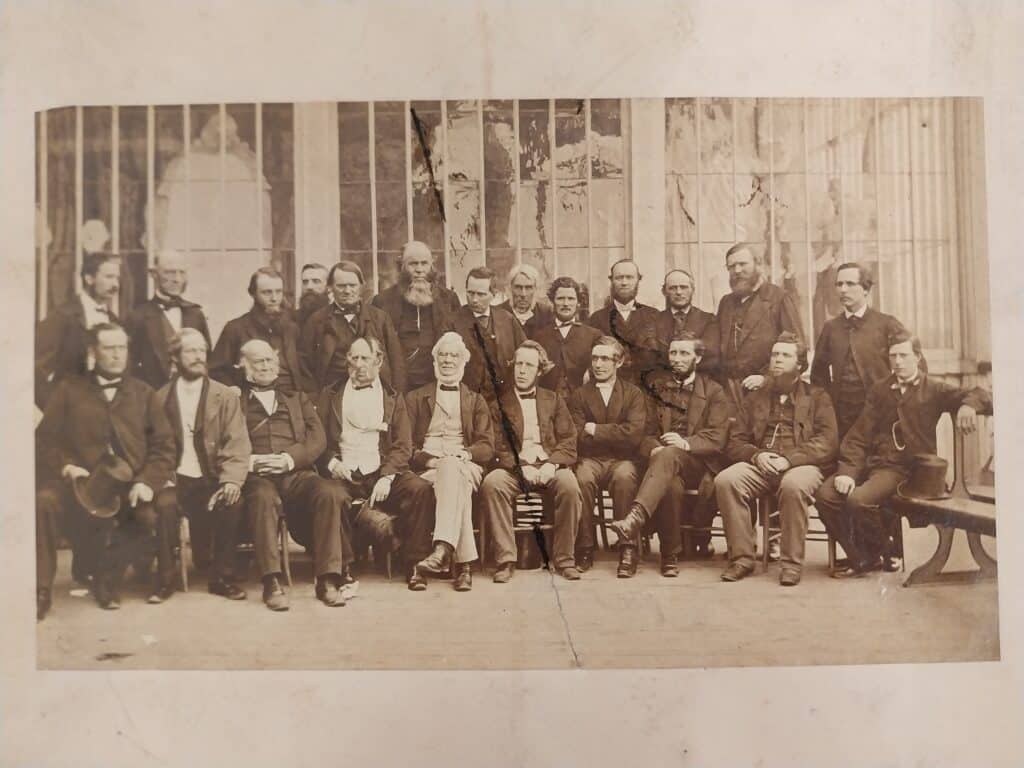

Research Acknowledgment: Special thanks to Fran and colleagues for their thorough research and valuable contributions to this report.
Researched and written by Marie-Clare Kenyon on behalf of Wigan Local History and Heritage Society for the ‘King Street, The Street That Was’ Heritage Action Zone Project 2020-2024
SOURCES OF INFORMATION:
Past Forward
Wigan World
British Newspaper Archives
Ancestry
Find My Past
A special thank you to John Baldwin for his invaluable input and support.
Copyright © 2024 All rights reserved
Wigan Local History and Heritage Society for The King Street Project
Read more Wigan history articles below…

New Members, click on the link below and complete our simple online form to become a member:
Please click here to join now
Existing members, please click on the link below and complete our renewal form:
Please click here to renew your membership