Victoria Building, 36-44 King Street
This picture (the date is unknown), shows a large funeral cortege arriving at the Free Methodist Church at the east end of King Street. It gives a clear view of the Victoria Building (with signs for Bodega bar, Eureka store established around 1900) and the junction of College Avenue. In the background are numbers 26-34 King Street, Georgian style houses covered elsewhere on the website.
By Wigan Local History and Heritage Society for The King Street Project
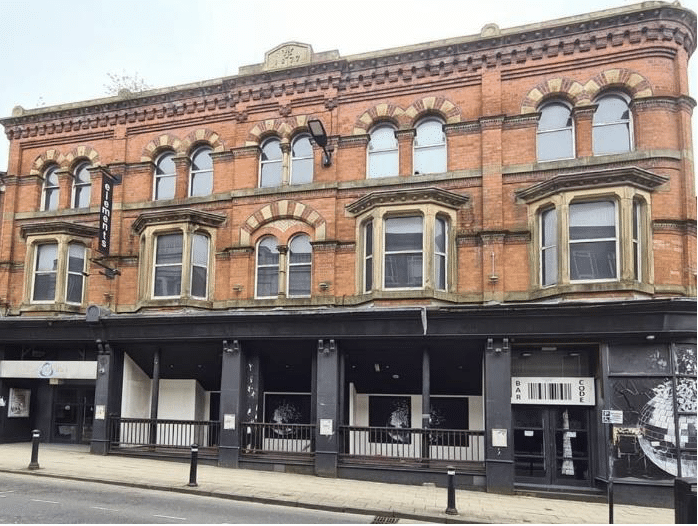
Victoria Building is situated between 36-44 King Street and the corner of College Avenue. Although it is not a listed building it lies within the Wigan Town Centre Conservation Area.
The building was commissioned by James Whitfield, an ironmonger who owned Clarington Brook Forge and Iron Foundry in Darlington Street East which later became Bulldog Tools. The grand opening celebrated in a newspaper article of 1877 reports that it was designed by Mr. George Heaton, (1831–1899) a local architect and was built by James Fairclough’s company. The article also recognised Mr. John Johnson, a bricklayer, and Mr. Mooreby, a plasterer in attendance at the opening along with other dignitaries.
The Planning Application for the building was approved by Wigan Council on 17 May 1876 for a commercial property with a basement and three floors above. The original building had two shops either side of the central main entrance. A central door gave access to the basement and smaller offices above. As it stands today, you can just make out the four bays on first floor with a central window which would have stood above the original entrance.
The building formally opened on 15 September 1877 and initially James Whitfield transferred his ironmongering business into the building. Later the same year adverts can be found in local newspapers for butter and bacon markets taking place in the building, although it is not clear from the records where these were positioned.
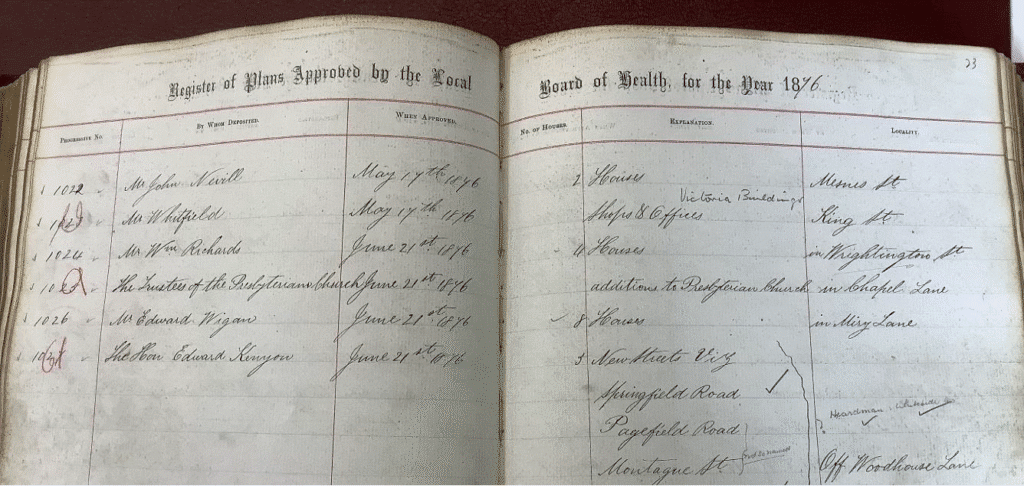
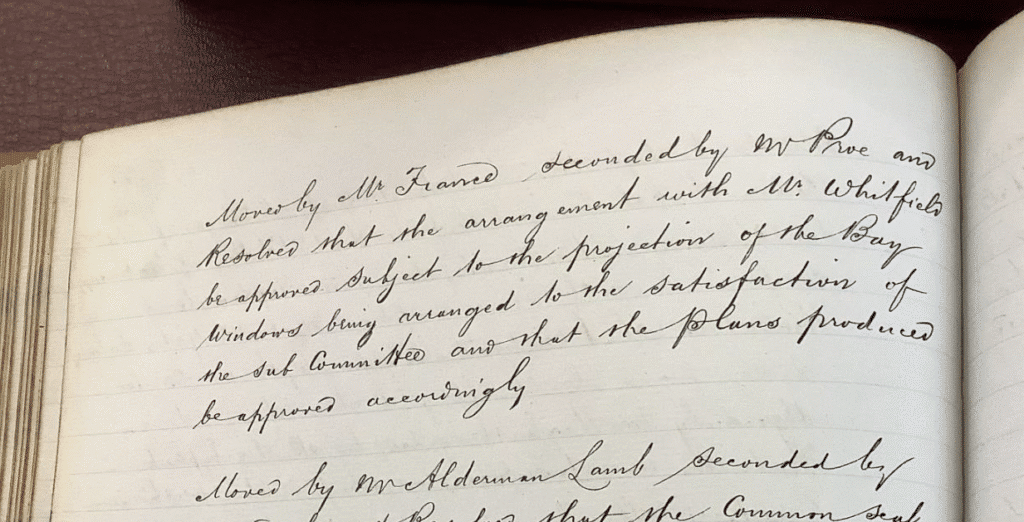
The photographs above shows the Register of Plans approved by the local council in 1876 (Archives: Wigan and Leigh) and the Council Minutes reflecting the decision and agreement to build.
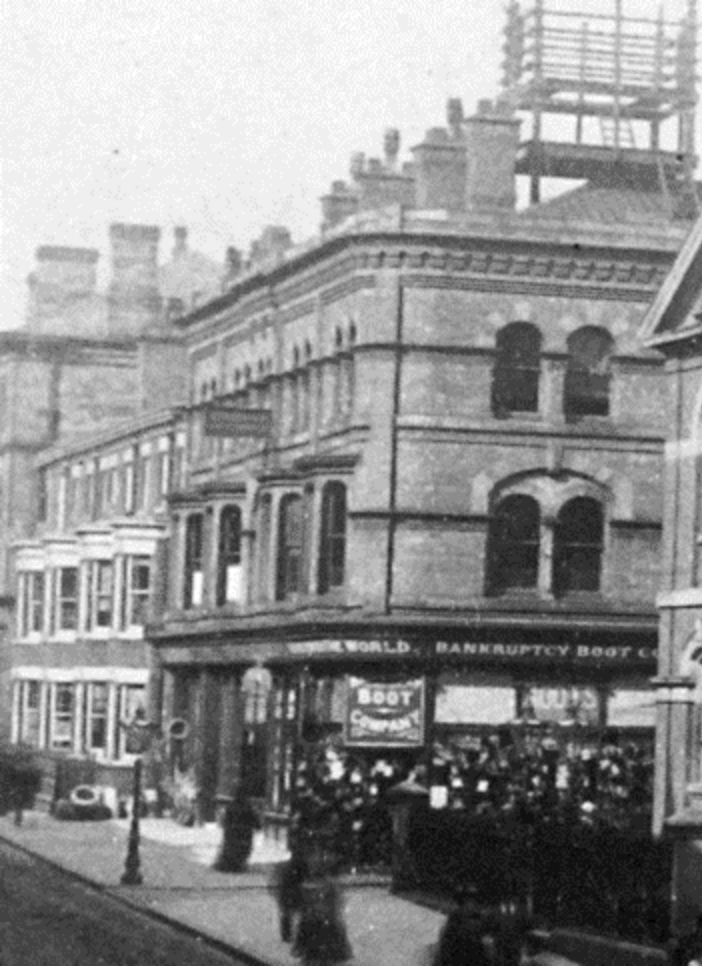
Victoria Building around 1882-1892 (Courtesy of Archives: Wigan and Leigh) showing the entrance on King Street and College Avenue, to the side. The timber frame on the roof could have held telegraph wires for the Telephone Exchange on the third floor. The building to the right was the Methodist Free Church which was demolished in the 1970s and replaced by a Tesco supermarket.
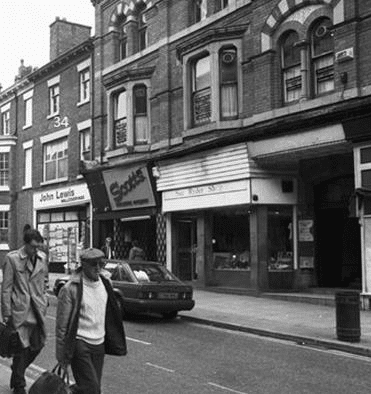
This photograph is believed to be from 1980s and shows some of the original layout of the building (on the right of the picture) with a central doorway and two shops either side.
Organisations and Individuals
Throughout its life of approximately 145 years, most of the building has been used for shops and restaurants. Census data between 1881 and 1939 show very little residential use of the building. Over the years many professions came and went from the building, including professional surveyors, architects, civil engineers, accountants, insurance companies, stock and sharebrokers and shop owners. One consistent were food and entertainment trades. There have been several bars, restaurants and more recently night clubs in the building up until 2021.
Restaurants
The year the building opened, the Victoria Restaurant opened in the basement. It was recorded by the Wigan Observer in November 1878 as the first public restaurant in Wigan. Shortly after it changed its name to Horder’s restaurant, the restaurant advertised “dining in Grand Saloon from one shilling. Facilities included a private dining room for ladies, a large smoke room with access to all with chess and draughts and all the leading papers available.”
In 1880 the restaurant was advertised as being under new management by Mrs. A Leyland and the Victoria Restaurant was to be known as the Wigan Restaurant Company. Four years later in 1884, an advert appeared giving details of the winding up of the Wigan Restaurant Company.
In 1888 the Victoria Restaurant reopened, (Wigan Almanac, 15 March 1888) before changing the name again, this time in 1891 to The Garrick. The census of that year recorded Rachel E Burrows and Elizabeth Thomas as waitresses.
During 1895 the manager and beer seller Mr. William Harrison was found to have people in his licensed premises who did not live there and he was charged with the unlawful sale of intoxicating liquor to non residents after hours.
In September 1899 the landlord of the Garrick Restaurant by now, Mr. Hall, applied for permission to make some internal alterations. (Wigan Observer, 30 September 1899). He proposed turning a large part of the building into a high class luncheon bar. The planned alterations went ahead in November 1899 making an entry from College Avenue.
Renamed again around 1900, the now Bodega Bar and Café hosted a dinner in 1905 for the Wigan water polo team relating to the new ‘baths’ to be opened in Millgate. An after-dinner concert was held at the Orange Hall, King Street.
Several requests were made to make alterations to the building from November 1909, some were refused. The licence was transferred to Mr. Alfred Silvester who is shown on the 1901 and 1911 censuses as living next door at 28 King Street with his wife Rosa Ann and their children. He died in 1917 age 50 and his wife continued to manage the bar for several years. It changed its name again in 1924 to the Bodega Co. Ltd. Wine Merchants.
The name is believed to have continued until around 1983 when it became the Bier Keller, then merged with the Transport Club and became the King of Clubs, exact dates and positions are not known. Continuing the theme with name changes in 1992 the former Bodega Bar/Bier Keller, changed to Leo’s, then, The Movies, then JR’s. Two years later the space was made bigger, and the entrance moved when the freehold of the whole building was sold to Luminar Leisure. There have been many name changes of the nightclub namely, Leo’s Barn in 1979, Liquid Nightclub in 2005-2011, Elements in 2012 and finally Evolution 2016 to 2020.
Shops, Meeting Rooms and Offices
The original entrance was in the centre with two shops on either side. Numerous occupants came and went over the years. Some of the longer and more notable occupants are noted below:
A shop selling bicycles, tricycles, bassinets and mail carts between 1891 and 1920s and managed by Mr. H H Timberlake. In 1924, adverts included the sale of automobile engines.
In the mid 1880s, Smith’s Bicycles moved from number 16 to number 30. Mr J. Smith and Sons – selling bicycles and then pianos. The company advertised themselves in 1893 as, the best and cheapest shop in Wigan for hiring pianos and organs. On the same newspaper page, they advertised sales of old and new violins, harps, guitars, banjos, flutes, clarinets, and concertinas along with all kinds of strings and fittings. A later advert in 1904, June stated, “Smith’s are without doubt Agents for the World’s best Bicycles”.
In May 1923 two adverts can be found on the same page for Timberlake’s and Smith’s Bicycles both in King Street.
Picture frame maker Mr. Emmanuelle Vitali (1862- 1934), born near Lake Como in Italy was recorded as a fine art dealer in the 1891 census with a shop in Pemberton. This was scheduled for demolition in 1894 when he moved to King Street. A year, later in 1895, Kelly’s Trade Directory (a national listing of businesses and trades people in any city or town as well as a general directory of postal addresses of local gentry, landowners, charities and other facilities) records him based at 30 King Street. Further advertisements recorded “Mr Vitali, Picture Frame Maker, wholesale, retail catholic repository. Best and cheapest place in town. Door on the right inside the building from King Street main entrance.” (Wigan Observer, December 1906 and May 1907).
A hatter and hosier, Mr. William Ollerenshaw, (1843-1929) was another familiar name for many years in King Street selling from number 32. An advertisement in the 1881 Wigan Trade Directory recorded him as a “Practical Hatter and Gents outfitter, oldest established in Wigan”. During 1890 he advertised new shapes in silk and felt hats. In 1909 he was recorded as a hat manufacturer (advert in Wigan Observer and District Advertiser).
Many adverts in the local newspaper show the variation of trades based in Victoria buildings, examples of these are listed below:
• Bankruptcy Boot Company, selling boots and shoes, advert in Wigan Observer, 26 December 1891
• Eureka shop sales – cook ware
• Kimoc Medicine specialist and experts located at 34 King Street advert in Wigan Observer, 20 December, 1913, page 8 and 3 January, 1914 page 4
• 1916 new Gas Showroom opens advert in Wigan Observer March 4, 1916
• Hilton’s Boot Shop, on the corner of Victoria Building
• Hilton and Leyland estate agents from 1902
• Wigan Conservatoire of Music opened new teaching rooms at number 18, Mr. W Grimes in 1906
• Ernest Wyatt Ralph, architect, had offices in the building between 1910-1914
• Messrs Platt and Fishwick, solicitors
Read More
Wigan School Board
This was accessed by the side door entrance on College Avenue. An outline of the door is still visible although blocked up.
The first Wigan School Board meeting was held in Victoria Building in 1878, presided by Mr. France, present were Messrs. JM McClure, W Berry, J Hill and Mr Lever Robert Rowbottom, Esq., who was Clerk to the Wigan School Board at the time. (WODA 11 Oct 1878).
School boards were public bodies in England and Wales between 1870 and 1902, which established and administered elementary schools.
Created in boroughs and parishes under the Elementary Education Act 1870 following campaigning by George Dixon, Joseph Chamberlain and the National Education League for elementary education free from Anglican doctrine. Education remained not free of fees. Members of the board were directly elected, not appointed by borough councils or parishes. Responsibilities of each board included:
• raise funds,
• build and run non-denominational schools where existing voluntary provision was inadequate.
• subsidise church schools where appropriate.
• pay the fees of the poorest children.
• if they deemed it necessary, create a by-law making attendance compulsory between ages 5–13 – until the Elementary Education Act 1880 when it became compulsory for all.
• not to impose any religious education, other than simple Bible reading.
Unusually for the time, women were eligible to win election to school boards. When the first elections were held, in 1870, seven women were elected across the country: Anne Ashworth and Caroline Shum in Bath, Catherine Ricketts in Brighton, Lydia Becker in Manchester, Marian Huth in Huddersfield, Eleanor Smith in Oxford, and Jennetta Temple in Exeter.
Following a letter from Education Department Privy Council in March 1872, eleven members were elected without contest to the Wigan School Board.
They met monthly at Wigan Borough Courts on Rodney Street until July 1878 when they moved to meet in the new Victoria Building offices. The last meeting at the Victoria Building was held in September 1903.
Wigan Rural District Council
The Wigan Rural Sanitary Authority was set up in 1872 under the Public Health Act (1872) following an application by the Wigan Board of Guardians. It included the townships of Dalton, Haigh, Parbold, Shevington, Worthington and Wrightington. It was later superseded by a Rural District Council covering the same area, the first meeting of the Council was held in December 1894.
Offices of the Clerks to the Board of Guardians
The Wigan Poor Law Union officially came into existence on 2 February 1837. Its operation was overseen by an elected Board of Guardians, 28 in number, representing its 20 constituent parishes and townships. The population falling within the Union at the 1831 census had been recorded as 58,402 with parishes ranging from 124 to 20,774 in Wigan itself.
The Wigan Union Workhouse on Frog Lane was built by a local firm James Fairclough and Son. The foundation stone was laid in April 1856 and it opened in December 1857.
The Board of Guardians held their first meeting in their new board room at Frog Lane on Friday 5 March 1858. Later offices could be found in both Victoria Building and Leader Building on King Street. Two of the towns prominent people, Mr Henry Ackerley, followed by Mr H Gordon Ackerley, spent a several years as Clerks to the Board of Guardians.
The last Chairman, appointed at the meeting on Friday 19 April 1929 was Gordon McGregor Esq. The Wigan Board of Guardians was abolished on 1 April 1930 following the Local Government Act of 1929, with responsibility passed to Wigan Corporation. After many years Wigan Workhouse had finally been consigned to history. Boston House Health Centre an NHS facility now stands on the site.
Wigan Coroner’s Office
Several Wigan coroners had offices in Victoria Building before moving across the road to the Leader Building. Prominent gentlemen, whose names appear in various roles over the decades, held the post of Coroner for the Town.
One of the longest serving Coroners in the country was Mr John Hopwood Sayer (1888-1975). After attending Wigan Grammar School then Rossall School, near Blackpool, he was apprenticed (articled) to solicitor and former town clerk, Howard Devon. He was admitted as a solicitor in 1912 and became a Deputy Coroner in December 1913.
In August 1918 following the passing of the Jury’s Act allowing coroners to dispense altogether with juries he held the first inquest without a jury. He continued to serve until 1968.
The Wigan Mission of Apostolic church
Also known as Catholic Apostolic Church, this was listed in Kelly’s Trade Directory as being at Victoria Buildings, between 1891 and 1918. Although registration as a place of public worship and for the solemnization of marriages was considered in 1903, no records have been found, it is thought this was probably never realised.
No records have been found to gain additional information. Archives: Wigan and Leigh believe a Baptismal Register was kept at the time but does not survive. (WLA Wigan minutes and register of services D/NCa Ap, 2 files, Acc. 1859.)
Telephone Exchange
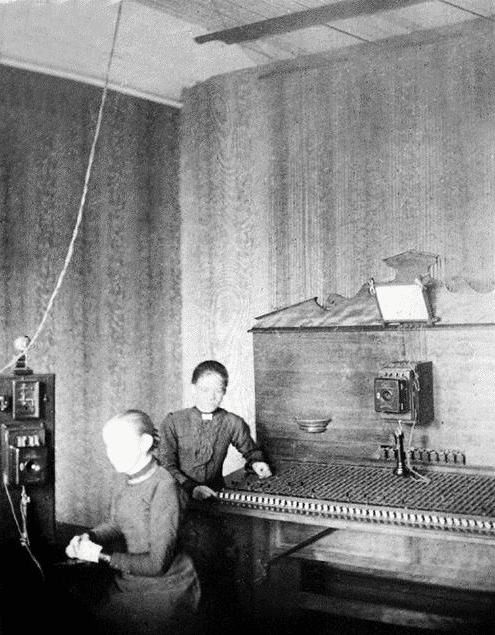
The Wigan Telephonic Exchange was situated on the second and third floors of the building. Opening on 1 April 1882 the Wigan Observer (1 April 1882, page 2a) stated that “shortly it is expected to be connected with those in Manchester, Liverpool, Blackburn and most of the leading towns in Lancashire, and local members will be able to converse with their fellow subscribers in those places at their own offices”.
A letter dated 17 July 1883, held in the Archives: Wigan and Leigh shows the Town Clerk’s office advised the Lancashire and Cheshire Telephonic Exchange Company Limited that “Wigan Corporation had sold the triangular plot in King Street on which they had erected a telephone pole and were respectfully asking for the pole to be removed within one month“. Wigan Corporation minutes note permission given initially for a pole to be erected on a piece of land opposite the fish market on condition that it be removed when they receive a letter giving them three months’ notice.
A newspaper article in May 1892 describes the visit of students from Wigan Mining and Mechanical School;
“where the whole system of working, as well as the detailed construction of the apparatus was kindly explained by Mr. Mewburn, the Manager, and Messrs. Williamson and Dagger, Electricians.
The students were first taken to the top of the building where the standards are fixed to which the wires from the different subscribers converge, and from which they are cabled down in boxes to a terminal board in the central offices. From this they were taken to the switch board which has one hundred down strips of brass and thirty-six cross strips, also of brass. The down strips relate to the end of a subscriber’s number, the cross strips being for the purpose of conveying the current from one down strip to another.”
The 1901 census records Mr. John W Harre an Electrical Engineer at number 18 Victoria Building, and the residents of numbers 19 & 20 as Mr. William H Wetton, age 38, a Telephone Operator from Liverpool and his wife and children. It is unclear what the facilities were for a family to reside.
In April 1910 the Wigan Observer and District Advertiser published an advert for “a smart youth wanted for office – apply by letter to National Telephone Co. Ltd.”
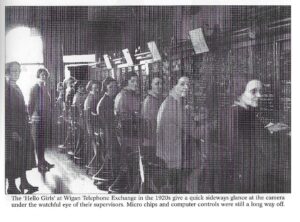
In March 1933 Wigan’s Mayor, Councillor James Horne, opened Wigan’s Automatic Telephone Exchange in Dorning Street, Wigan.
This was regarded as being “more than a telephone exchange” It was Wigan Group Switching Centre: which included an automatic (Strowger) telephone exchange, manual switchboards, test desks and a repeater station, amongst other things. The object of the automatic telephone exchange was to dispense with the assistance of a third party in making connection between two subscribers. (Ref: S., M. The Automatic Telephone Exchange. Nature 67, 40–41 (1902). https://doi.org/10.1038/067040a0)
Shortly after opening, all services moved, leaving the third floor of Victoria Building empty until BT opened planning and drawing offices in the previous telephone exchange office during 1960’s.
From 1961/2 Dorning Street was the main switch exchange before the introduction of subscriber trunk dialling. The telephone exchange and its associated technology then on Dorning Street (standing on the corner with King Street West).
In the early 1960’s the Assistant Executive Engineer in charge of Post Office Telephones’ Group Switching Centre (Wigan) was Harry Ridgeway and the Higher Technical Officer in charge of the test desk was Joe Unsworth.
From 1991 the initial state of the art building in Dorning Street has stood empty.
In conclusion, if walls could talk, I am sure Victoria Building could tell some tales. Whilst the external brickwork of Victoria Building still exists, sadly it is unclear if any of the internal structures remain. The building has had many planning requests made for change of use, structural changes including and the movement of doorways. In 1976 number 3 Victoria Buildings requested permission to erect a radio mast on the roof, offices changed use from betting shop to wholesale tailoring businesses, record exchanges and sales of books, stamps and antiquities. Clubs were transformed into retail shops, then back to cellars and beer lounges. In 2021 an application was made for a further change of use of the building residential. This is due to start in 2023/4.
Read more Wigan history articles below…


Join the Wigan Local History and Heritage Society
New Members, click on the link below and complete our simple online form to become a member
Please click here to join now
Existing members, please click on the link below and complete our renewal form:
Please click here to renew your membership